
Most business strategies are permission slips to stay busy.
Everybody gets a priority. Every department keeps its favorite project. Nobody has to kill anything important. The finished plan is politically impressive, financially vague and long enough to stop reasonable people from reading it twice.
Then the company spends a year executing it.
New marketing. New software. New hires. New markets. An AI initiative with a name, a committee and no identifiable business outcome. Possibly a podcast, because apparently the market was waiting for twelve episodes of two executives agreeing with each other.
The business gets busier. Costs arrive immediately. Results develop a more relaxed attitude toward the schedule.
That is not an execution problem.
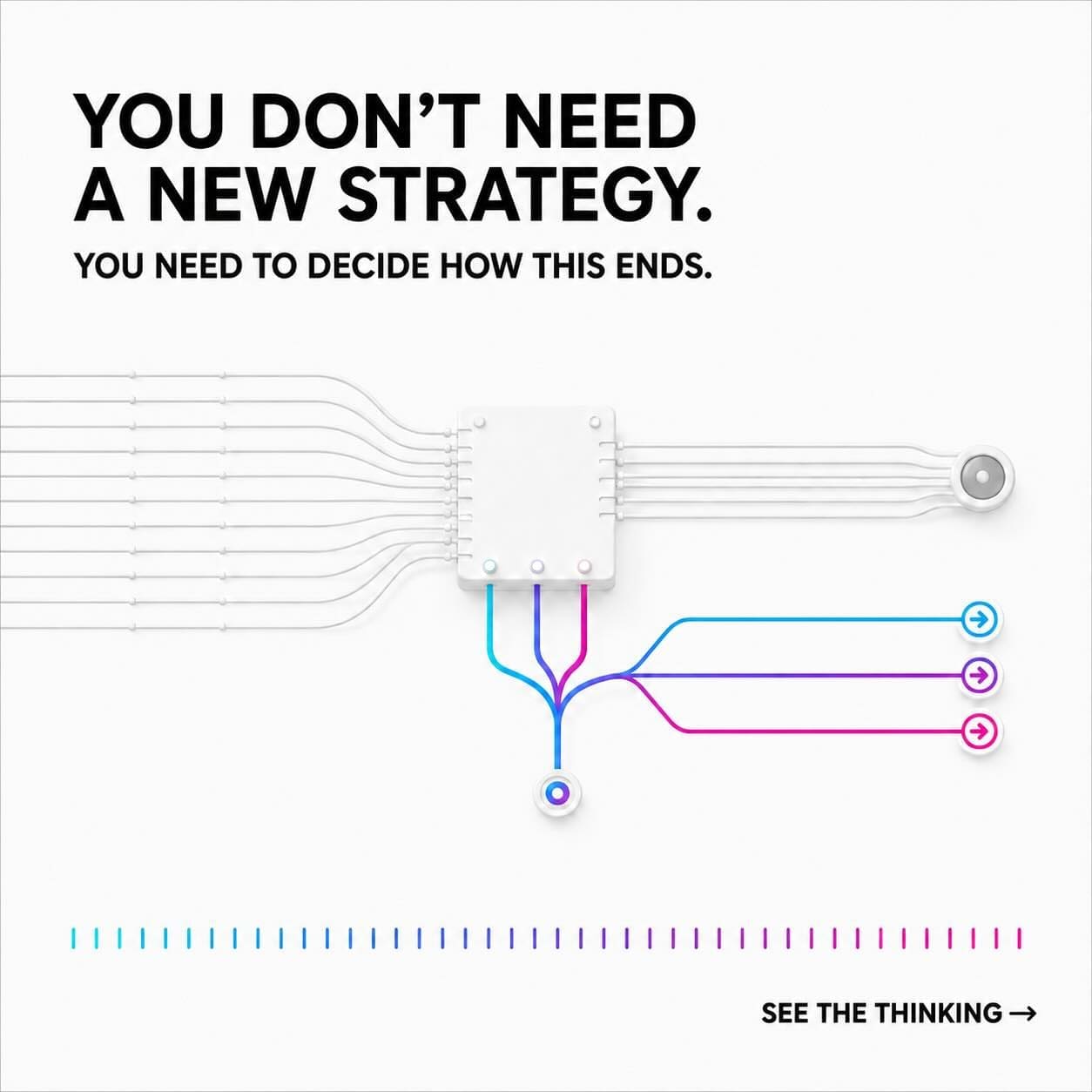
The company never decided how the story was supposed to end.
“Growth” is not an ending
Ask a company what its strategy should accomplish and the answer is usually growth.
Fine. Growth into what?
More revenue at the current margin? Fewer customers paying more? A recurring model? Less dependence on the owner? Faster cash conversion? A company somebody might eventually want to buy?
Those are not different descriptions of the same destination. They are different destinations.
A company can increase revenue by 20 percent and still become less profitable, more fragile and more dependent on the owner. The chart moves up. The business moves backward.
Nothing failed in execution. The company executed the wrong ending extremely well.
This is what vague outcomes protect. They let everyone celebrate activity before anyone asks whether the activity is building a better business.
“Increase revenue” sounds decisive until the company discovers it bought that revenue with lower margins, longer payment terms, more operational complexity and three new employees who now require meetings about the meetings.
Revenue is not the ending. It is one number inside the ending.
Most strategy begins too early
Traditional planning usually starts with the company as it exists today:
What are we doing now? What resources do we have? What opportunities are available? What should we add?
These questions feel practical. They also make the current business model the default answer before the real question has been asked.
The result is usually a larger, more expensive version of the company’s existing problems.
Ygetarts starts from the other direction:
What must be different when this is over?
Not what would be nice. Not what will make the presentation look ambitious. Not “innovation,” “transformation” or “customer centricity”—phrases with the remarkable ability to consume a budget without leaving fingerprints.
What must actually be true?
Perhaps no customer represents more than 15 percent of revenue.
Perhaps the owner is no longer required to approve every meaningful decision.
Perhaps the company earns more without producing more.
Perhaps cash arrives before the work begins instead of 60 days after everyone has forgotten why the invoice was controversial.
Perhaps the business needs to become simpler before it earns the right to become larger.
Now there is an ending.
And once the ending is specific, many attractive ideas become obviously useless.
That is not a limitation of strategy. That is the point.
Good strategy should destroy work
Companies often judge strategy by how many initiatives it creates.
That is backwards.
The first job of strategy is elimination.
It should kill projects that do not support the ending. It should expose customers whose revenue is less valuable than the complexity they create. It should stop technology purchases searching for a reason to exist. It should make some meetings unnecessary and a few internal empires noticeably smaller.
If the strategy adds fifteen priorities and removes nothing, it has not established direction. It has increased the company’s surface area for failure.
This is why a clear ending matters. It becomes a decision filter:
Does this customer move us toward the business we are building?
Does this hire remove a constraint or merely add capacity to a broken process?
Does this offer improve margin, repeatability or strategic control?
Does this technology change an important decision—or simply allow us to perform low-value work with greater enthusiasm?
A strategy that cannot say no is not a strategy. It is internal diplomacy with a budget.
Work backward from what must be true
Suppose a company defines this ending:
Within 12 months, 30 percent of revenue will come from repeatable, higher-margin work that does not require the owner to manage every engagement.
That is specific enough to create useful discomfort.
Now work backward.
What will customers buy repeatedly?
Which parts of the current offer create value, and which parts are customization performed out of habit?
What knowledge is trapped in the owner’s head?
Which decisions must the team make without permission?
Which existing customers can validate the model fastest?
What must be true for the work to be higher margin after reality has finished editing the spreadsheet?
The answers may reveal that the company does not need a new market. It needs to package an existing capability.
It may not need more leads. It may need to stop rebuilding the offer for every prospect until the margin dies of personal attention.
It may not need another employee. It may need a decision system that prevents the owner from becoming the most expensive approval button in the building.
Working backward changes the order of investment. The company stops buying resources and hoping they create an outcome. It identifies the conditions the outcome requires, then invests only where those conditions are missing.
That tends to produce fewer initiatives.
It also produces a strategy that can survive contact with a calendar and a bank account.
There is no path without a price
Once the ending is clear, there will still be choices.
One path may move faster but require more capital. Another may protect cash but keep the owner heavily involved. A third may take longer while creating a more valuable and less fragile business.
Ygetarts develops three executable paths because one recommendation often hides the most important part of the decision: what the company is agreeing to sacrifice.
There is no perfect path. There is only a tradeoff the company understands and one it discovers after paying for it.
Strategy should make that price visible before the invoice arrives.
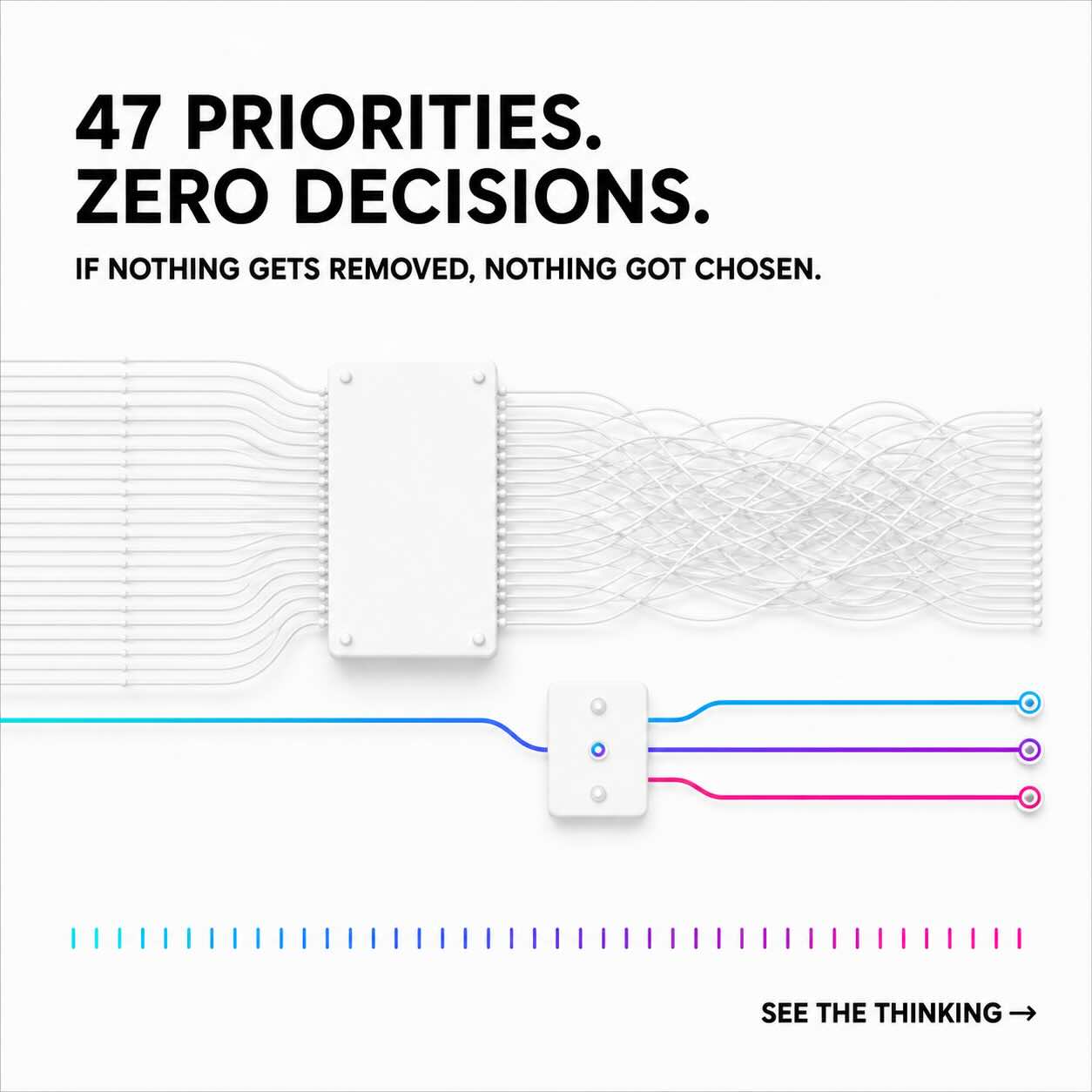
If the plan has 47 priorities, the company has not made 47 strategic decisions. It has avoided one.

AI has made this problem more expensive because capability is expanding faster than judgment.
Companies can now automate, summarize, generate, analyze and imitate at a speed that feels like progress.
But “use AI” is not a strategy.
Which decision improves?
Which constraint disappears?
Which cost structure changes?
Which previously impractical outcome becomes possible?
If the company cannot answer those questions, AI becomes another layer of activity placed on top of a business that already has too much activity.
The company does the same work faster and arrives early at the wrong destination.
AI can create enormous strategic leverage. It can also industrialize confusion. The difference is not the model. It is whether the business knew what needed to change before opening the toolbox.
Strategy, backwards
Ygetarts is strategy spelled backwards because we start at the end.
We define what must be true, identify what would prevent it, and engineer backward to the decisions the company has to make now.
Sometimes that produces a growth strategy.
Sometimes it produces a margin strategy, a different business model or the decision to stop doing something everyone had mistaken for essential.
The goal is not to make the business sound strategic.
The goal is to decide how this ends—before the company spends another year becoming busier, larger and no closer to the business it actually wanted.