
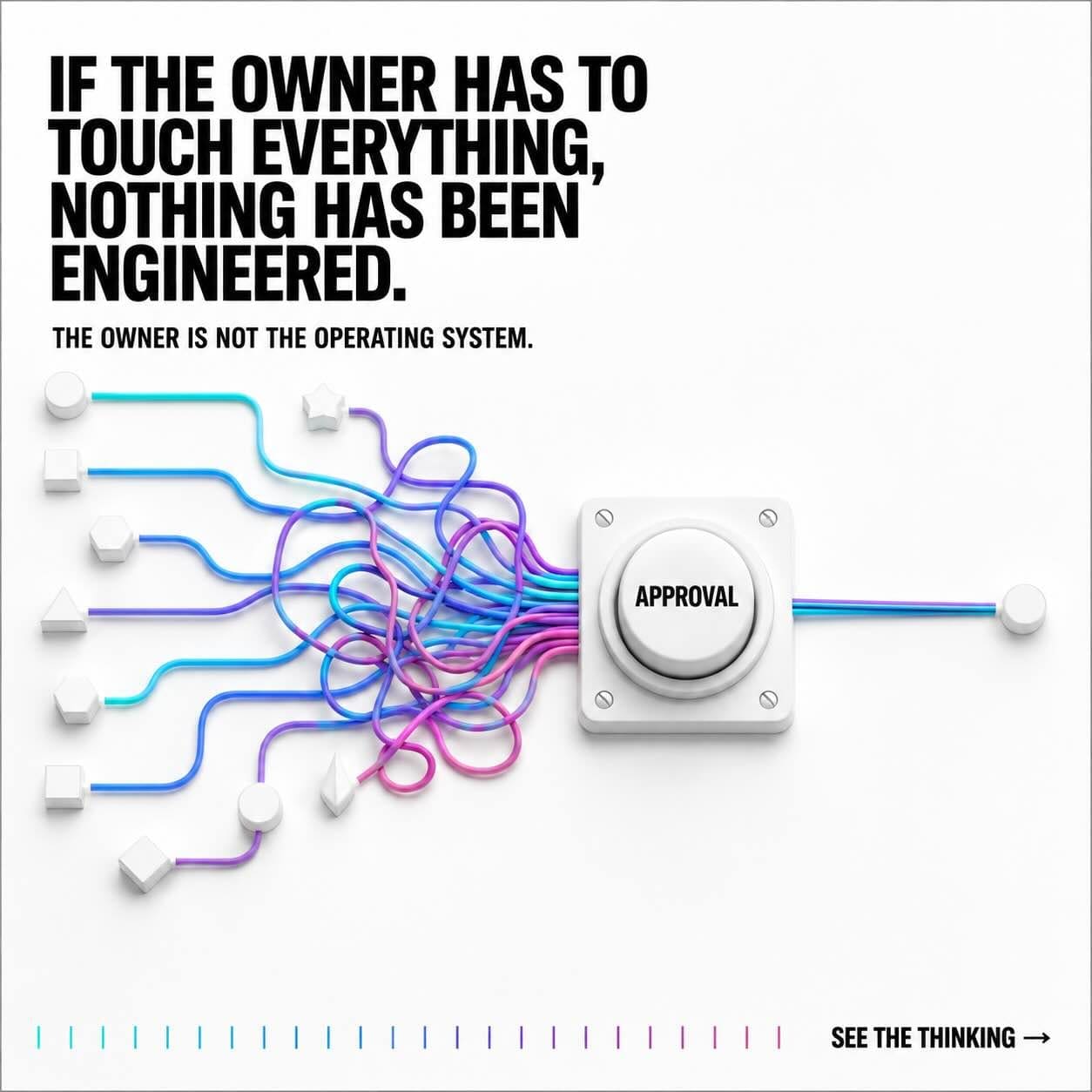
The owner is not the operating system.
If every important decision, exception, customer promise and final approval eventually lands on one person’s desk, the company has not built control.
It has built a queue.
That queue may look impressive because the owner is experienced, responsive and usually right. Customers ask for them. Employees trust them. Problems become less frightening when they enter the room.
So the company calls the arrangement leadership.
Often it is simply dependency with better public relations.
The owner’s judgment is holding the business together. But because that judgment has never been converted into rules, thresholds, information flows and decision rights, the company cannot use it without waiting for the owner to arrive.
The owner did not build a company that benefits from their intelligence.
They built a company that rents it by the hour.
Owner involvement is not the same as owner value
Owners should matter.
They should decide where the company is going, which risks deserve capital, which capabilities should be built and which customers or opportunities can change the future of the business.
That is owner value.
Owner involvement is different. It is the daily accumulation of approvals, clarifications, introductions, revisions and exceptions that reach the owner because nobody else has enough authority, context or confidence to finish the decision.
The distinction becomes obvious when the owner disappears for a week.
Strategic decisions can wait. Routine decisions should not.
If pricing stops, proposals stall, employees postpone commitments and customers begin asking when the owner returns, the company has learned something useful and slightly embarrassing.
The owner is not merely leading the system.
The owner is a missing part of the system.
The company is using a person to compensate for unfinished design
Most owner-dependent companies do not lack procedures.
They have procedures everywhere. Shared drives are full of them. Someone once created a seventy-three-page operations manual that now enjoys the peaceful retirement common to documents nobody uses.
The problem is not the absence of instructions.
The problem is that the instructions do not contain the judgment required to act.
An employee may know how to prepare a proposal but not when a discount is rational. A manager may know the service process but not which exceptions are worth accepting. Finance may know the customer is late but not whether the relationship justifies more credit.
The process reaches the decision and then stops.
The owner supplies the missing logic.
That may be efficient while the company is small. The owner sees more of the business than anyone else and can connect customer history, cash, capacity and risk in seconds.
But the advantage contains a trap.
Every time the owner rescues an incomplete process without improving it, the company learns to escalate instead of decide.
Competence at the top creates helplessness below.
The real bottleneck is not time
Owner dependency is usually described as a time-management problem.
The owner needs to delegate more. Block the calendar. Stop answering every message. Hire an assistant. Take a vacation dramatic enough to force the team to cope.
Those actions may create temporary relief. They do not repair the business.
The bottleneck is not that the owner has too little time.
It is that the company has too little encoded judgment.
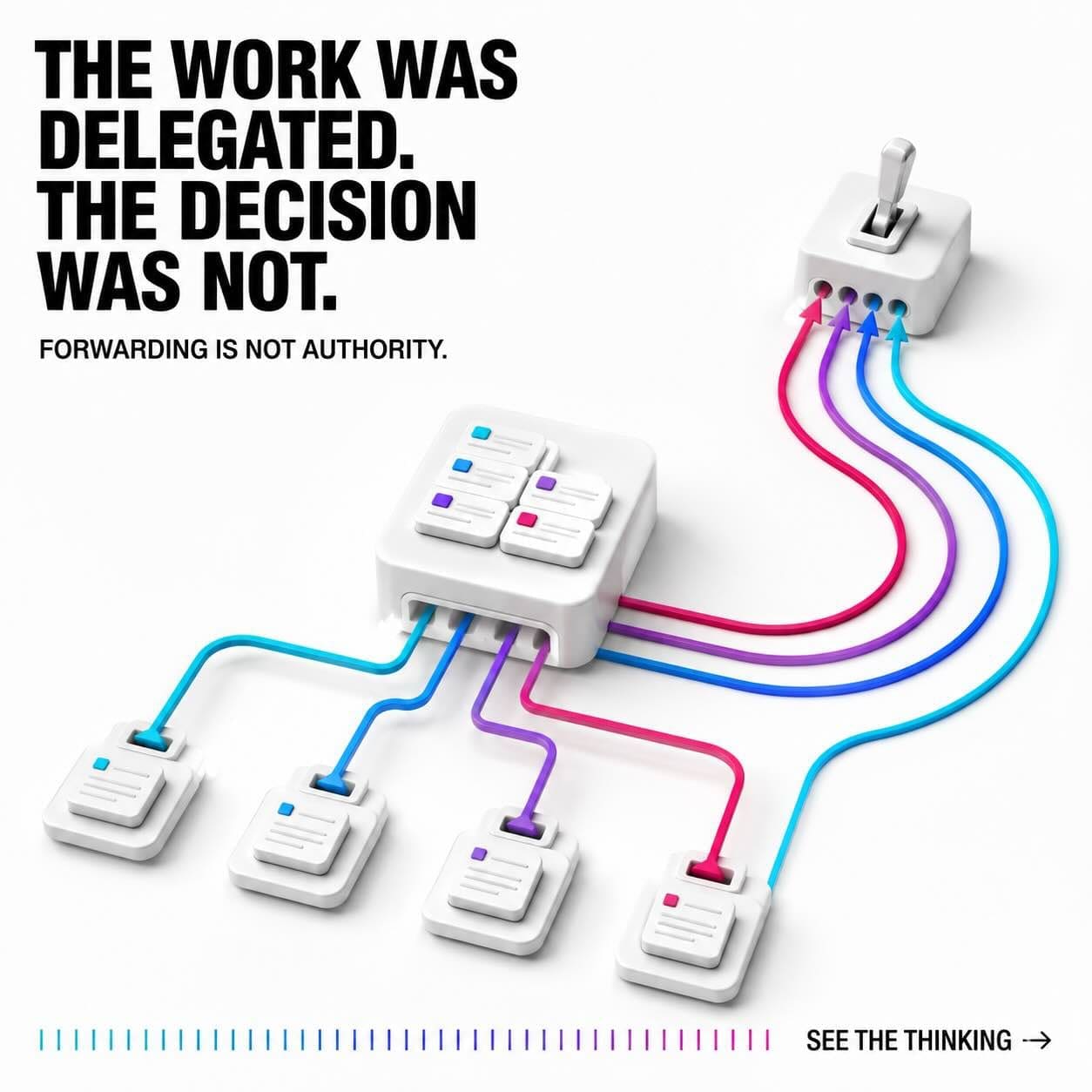
Delegation fails when responsibility moves but decision authority does not. An employee is told to own the outcome, then discovers that pricing, exceptions, spending and customer communication still require approval.
The work was delegated.
The decision was not.
Now two people are involved, the owner still has to touch it and the company has added a meeting to celebrate the improvement.
Real delegation requires more than handing over tasks. It requires defining what the person can decide, which information should guide the decision, where the boundaries sit and what must be escalated.
Without that architecture, delegation is just forwarding with optimism.
Every owner touch carries an economic cost
The obvious cost is the owner’s time.
The larger cost is what the business cannot do while it waits.
A proposal sits overnight because the discount needs approval. A customer issue travels through three people before reaching the one person allowed to resolve it. A manager delays hiring because the owner has not confirmed the role. Employees collect questions for the next meeting because asking permission has become safer than exercising judgment.
The delay rarely appears as a separate line on the income statement.
It appears as slower response, unused capacity, weaker employees, frustrated customers and opportunities that cool while the company searches for a decision.
Then there is the owner’s opportunity cost.
Every hour spent correcting routine work is an hour unavailable for capital allocation, market selection, business-model design, major relationships and the few decisions that genuinely require the owner’s perspective.
The company pays its most strategically valuable person to function as quality control for decisions the system should already know how to make.
That is not prudence.
It is an expensive allocation error.
Quality control can become a flattering excuse
Owners often remain involved because they care about quality.
Fair enough. Their reputation may be attached to every important outcome. They may have watched employees make expensive mistakes. They may know that customers notice details long before process consultants do.
But quality that exists only when the owner intervenes is not quality control.
It is quality rescue.
A controlled system defines the standard, makes the necessary information visible, gives someone authority to act and detects when the result moves outside an acceptable range.
An owner-dependent system waits for the owner to notice something.
Those are different operating models.
One produces repeatability.
The other produces a heroic owner, a cautious team and a company that becomes less valuable the moment the hero leaves the building.
The owner may genuinely be better at the work. That does not prove they should keep doing it. It proves the company has not yet transferred what makes them better.
Do not document tasks. Engineer decisions.
Most companies begin systemization by documenting what people do.
That helps, but it misses the difficult part.
Tasks are visible. Judgment is not.
The useful questions are:
- Which recurring decisions still require the owner?
- What information does the owner use that other people cannot see?
- Which thresholds cause the owner to approve, reject or redesign the request?
- What downside is the owner actually protecting against?
- Which decisions are reversible enough for someone else to make?
- What must be true before an exception deserves escalation?
These questions turn instinct into operating architecture.
Consider discount approval.
“Ask the owner before discounting” is not a system. It is a location.
A decision system might define minimum gross margin, available capacity, payment terms, strategic value, contract length and the concessions required in exchange. A salesperson can then make some decisions independently, escalate unusual combinations and explain why the economics work.
The goal is not to eliminate judgment.
It is to make judgment travel farther than the person who developed it.
Work backward from a business that can operate without permission
The wrong starting question is:
How can the owner become less involved?
That makes owner absence the objective. It can produce indiscriminate delegation, lower standards and an owner who is technically uninvolved but still receives emergency messages from the beach.
Start with the ending:
What must be true for the business to make reliable decisions without waiting for the owner?
Perhaps customer-facing employees need pricing boundaries instead of case-by-case approval.
Perhaps managers need live visibility into margin, capacity and cash rather than reports that explain last month with archaeological precision.
Perhaps exceptions need an explicit price and expiration date so they do not quietly become permanent operations.
Perhaps employees need permission to make reversible decisions—and a review process that improves the next decision instead of punishing the last one.
Perhaps the owner needs to stop correcting the answer and start explaining the logic.
Once the ending is clear, the company can engineer backward from it.
There are three executable paths
The first path is to remove the decision.
Standardize the offer, narrow the options or eliminate exceptions that create little value. The cleanest approval process is the one the business no longer needs.
The second path is to encode the decision.
Define the information, thresholds, authority and escalation conditions. Build the owner’s reasoning into the operating model so other people can reach a reliable answer.
The third path is to price the dependency.
Some work genuinely requires owner judgment. A major negotiation, unusual risk, strategic partnership or high-consequence commitment may deserve direct involvement. Treat that attention as a scarce resource. Reserve it for work whose economics or strategic value justify consuming it.
Each path has a cost.
Standardization reduces flexibility. Distributed authority permits mistakes. Protecting owner attention may disappoint customers accustomed to immediate access.
But the current model has a cost too.
It slows decisions, weakens accountability, limits growth and makes the company’s value inseparable from one person’s continued availability.
Refusing to choose does not preserve quality.
It preserves dependence.
The owner should become more important and less necessary
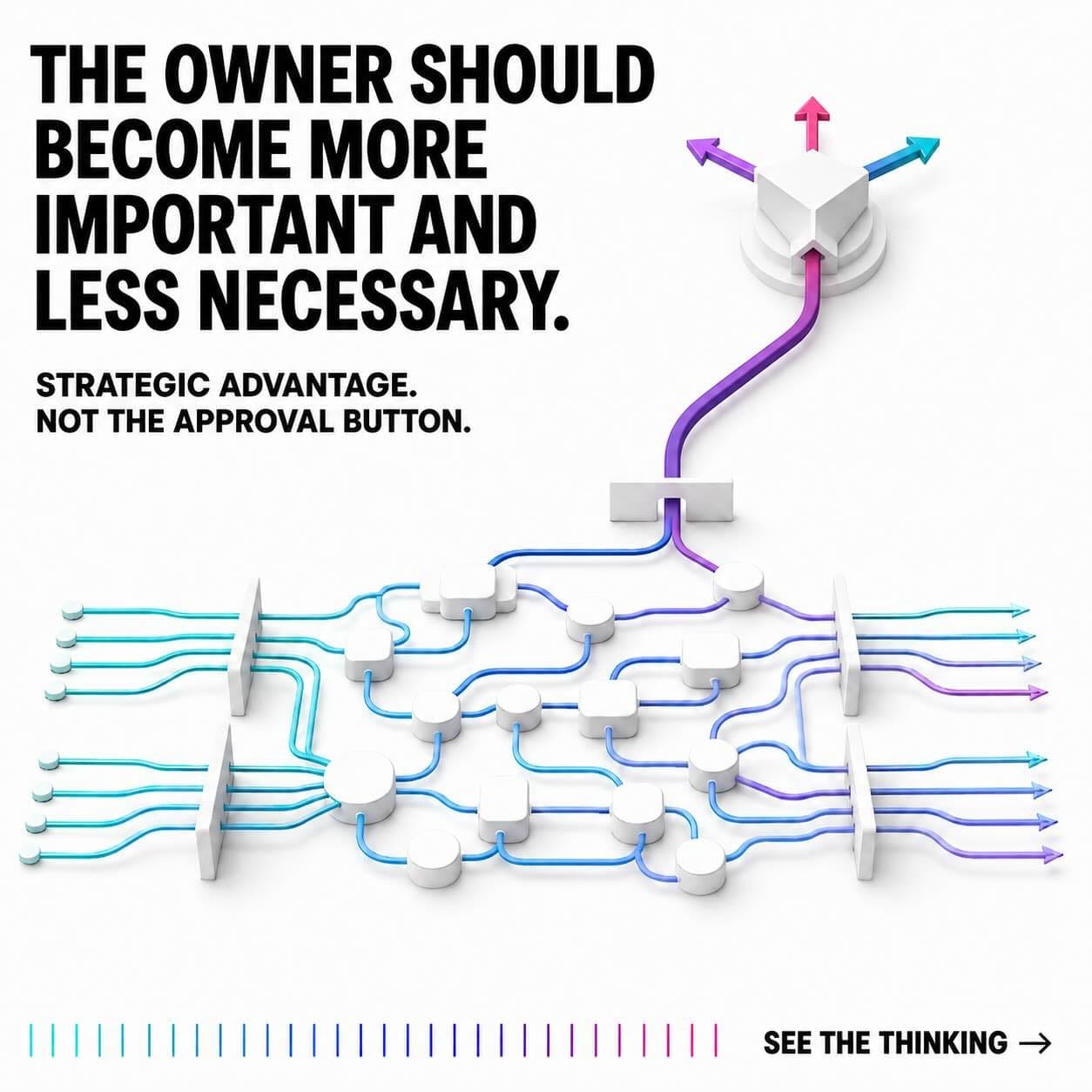
The objective is not to remove the owner from the company.
It is to stop wasting the owner on work the company should be able to finish.
A well-engineered business still benefits from the owner’s judgment. But it concentrates that judgment where it changes direction, protects significant capital or creates new capability.
The routine system carries what has already been learned.
The owner works on what the business has not learned yet.
That is the difference between a company built around an owner and a company built from what the owner knows.
If every important decision still needs one person’s fingerprints, the business is not controlled. It is waiting.
The owner should be the source of strategic advantage.
They should not be the approval button.