
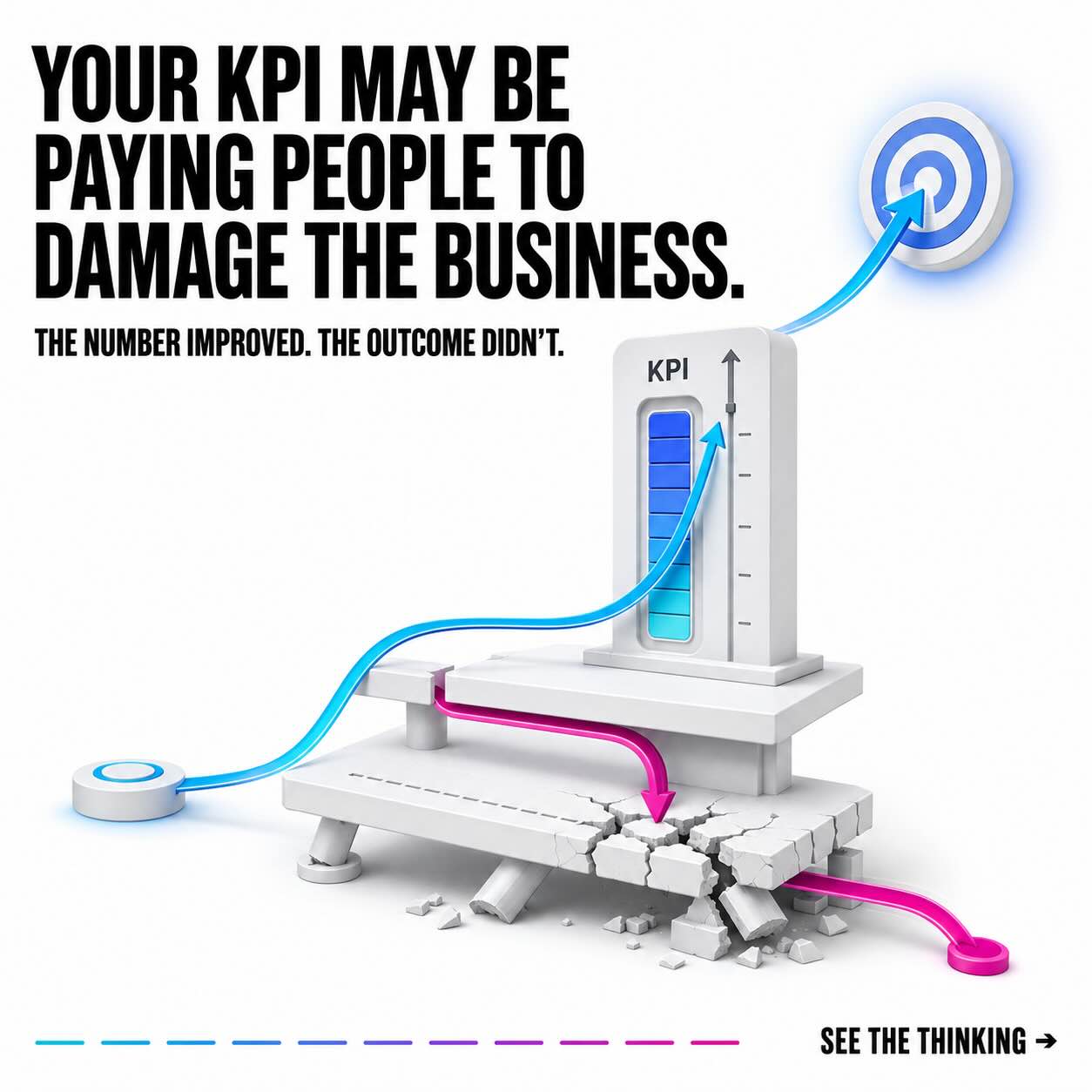
Your people may be doing exactly what you asked—and damaging the business in the process.
That is the uncomfortable part of a bad KPI. It does not merely fail to measure performance. It purchases the wrong performance.
Attach compensation, status, attention or fear to a number and the number stops being a report. It becomes an instruction.
Salespeople chase revenue that produces no margin. Service teams close tickets that customers have to reopen. Operations increases utilization until urgent work has nowhere to go. Purchasing reduces unit cost by buying inventory the company cannot use.
Then management studies the dashboard and congratulates itself on the improvement.
The KPI went up.
The business got worse.
A measure becomes dangerous when it starts making decisions
There is nothing wrong with measuring revenue, utilization, response time, output or cost.
The problem begins when a useful indicator is promoted into a substitute for the outcome.
Revenue is not profitable growth. Utilization is not productive capacity. Response time is not resolution. Output is not usable output. Lower purchase price is not lower total cost.
Each metric describes one part of a larger economic system. The moment people are rewarded for improving that part, they will improve it—often by moving cost, delay or risk somewhere the metric cannot see.
That is not necessarily dishonesty. It is adaptation.
People learn what receives praise, what affects compensation and what creates an uncomfortable meeting. The official strategy may live in a presentation. The working strategy lives in the scorecard.
If the two disagree, the scorecard usually wins.
The business pays for the number twice
The first payment is obvious: bonuses, commissions, promotions and management attention.
The second payment is hidden in the behavior required to produce the number.
Imagine a company that pays sales commissions on signed revenue. A large contract looks excellent on the sales report, so the salesperson discounts heavily, accepts custom requirements and promises a launch date operations cannot support.
Sales hits the target.
Now delivery absorbs the customization. Margin disappears into unplanned labor. Other customers wait. Finance chases weak payment terms. The account becomes strategically “important,” which is often corporate language for a mistake too large to admit quickly.
The commission was not the full incentive cost.
The company also purchased complexity, delay, margin erosion and future exceptions.
A KPI is expensive when the easiest way to improve it is to make another part of the business carry the damage.
Most bad KPIs are not false. They are incomplete.
This is why the problem can survive intelligent management.
The metric is usually accurate. Revenue really did increase. Ticket closure really did accelerate. Unit cost really did fall. Utilization really did reach 94 percent.
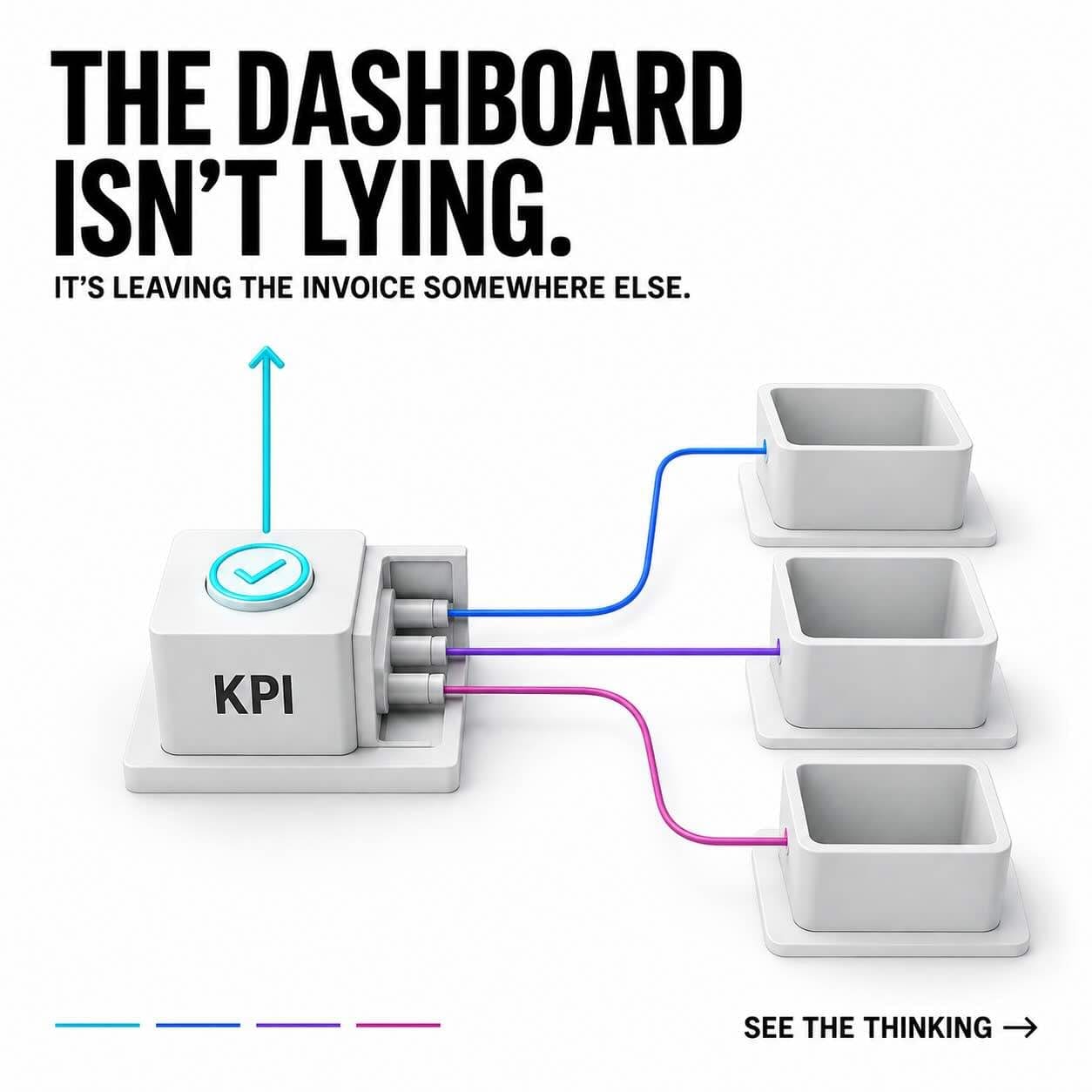
The dashboard is not lying.
It is telling a smaller truth than the decision requires.
A call center rewarded for short handling time can end calls quickly. If customers call back, churn or escalate, the handling-time metric still improves.
A plant rewarded for output can increase production. If defects, work in progress and maintenance risk rise elsewhere, the output metric still improves.
A manager rewarded for reducing headcount can lower payroll. If contractors, overtime, delay and knowledge loss rise afterward, the headcount metric still improves.
The metric captures the visible gain and leaves the invoice in another department, another month or another customer relationship.
That is how a locally rational decision becomes an enterprise-level mistake.
Every KPI needs an economic sentence
Before a metric earns a target, management should be able to complete one sentence:
Improving this number should improve the business because…
The ending must be economic and specific.
Not “because faster is better.” Better how?
Does faster response increase retention? Does higher utilization improve contribution margin without extending lead times? Does more revenue create cash after fulfillment, support and working capital? Does lower acquisition cost preserve customer quality?
If the connection cannot be stated, the KPI is operating on reputation.
Then test the sentence against actual results. When the number improved, did the intended outcome improve with it? If not, one of three things is true: the relationship was weaker than assumed, the benefit was delayed, or the metric was being improved in a way that defeated its purpose.
That last possibility deserves more attention than most dashboards give it.
The company may not have a performance problem.
It may have a measurement system successfully producing the wrong behavior.
Work backward from the outcome the metric is supposed to protect
The wrong question is:
What should our target be?
That question starts with the instrument before anyone has agreed on the destination.
Start with the ending.
Suppose the desired outcome is profitable, repeatable growth that does not overwhelm delivery or consume cash faster than the company creates it.
Now engineer backward.
What must be true about new revenue? It must clear a margin threshold. The work must fit the delivery model. Capacity must exist when promised. Payment terms must not turn growth into a financing problem. Customer concentration must remain tolerable. Exceptions must create enough value to justify the complexity they add.
Only then should the company decide what sales performance means.
Revenue may remain one measure. It simply cannot carry the whole argument by itself.
The same logic applies elsewhere. If the ending is customer trust, measure durable resolution rather than rapid closure. If the ending is reliable capacity, measure throughput with quality and lead time rather than celebrating maximum utilization. If the ending is lower operating cost, include the inventory, rework, delay and risk required to achieve it.
The metric should serve the outcome.
The outcome should not be rewritten to flatter the metric.
Pair every accelerator with a guardrail

Most performance systems need at least two kinds of measures.
An accelerator encourages movement. A guardrail identifies the damage the business refuses to accept while moving.
Revenue can be paired with contribution margin, cash collection or exception load. Ticket speed can be paired with repeat contact, escalation or customer retention. Output can be paired with first-pass quality, rework or on-time delivery. Utilization can be paired with lead time and available surge capacity.
The goal is not to bury employees under seventeen competing numbers. A dashboard that requires its own archaeological team is not control.
The goal is to make the tradeoff visible.
One measure says, “Move.”
The other says, “Do not achieve movement this way.”
Guardrails also reveal whether the target is realistic. If revenue can hit plan only by violating the margin floor, the sales team is not necessarily failing. The plan may be asking the business to produce economics that the market, offer or delivery model cannot support.
That is useful information.
Punishing people until the contradiction disappears from the meeting is not.
Incentives need a delay long enough to reveal the damage
Many KPIs pay immediately for benefits whose costs arrive later.
The contract is signed this month. The implementation overrun arrives next quarter. The customer pays late. The special feature becomes permanent. The discount becomes the reference price for renewal.
By then, the celebration has happened and the cost belongs to somebody else.
That timing gap makes bad business look like good performance.
The answer is not to postpone every decision until perfect information appears. It never will. The answer is to align part of the evaluation with the period in which quality becomes visible.
Sales performance can include margin after delivery, collection, retention or the cost of approved exceptions. Service performance can include whether the issue stayed solved. Operating performance can include what happened to defects, backlog and maintenance after the output surge.
When consequences arrive later, some accountability should arrive later too.
Otherwise the company rewards the opening move and leaves the rest of the business to play the position.
There are three executable paths
The first path is to repair the metric.
Keep the measure, but define it more honestly. Replace gross revenue with qualified revenue, booked margin, collected margin or another measure closer to the desired economics.
The second path is to constrain the metric.
Use a simple accelerator, but add clear guardrails. Revenue counts only above a margin floor. Speed counts only when the problem remains resolved. Output counts only when it meets quality and delivery requirements.
The third path is to remove the incentive.
Some measures are useful for observation and dangerous for compensation. Track them to understand the system, not to tell people what to optimize.
Each path has a cost.
More complete metrics can be harder to calculate. Guardrails reduce local freedom. Delayed evaluation makes compensation less immediate. Removing an incentive may expose that management has been using a number to avoid a more difficult conversation about judgment.
But leaving the KPI untouched also has a cost.
The business keeps paying people to improve the evidence while weakening the result.
The dashboard is already running part of the company
KPIs are often discussed as if they sit outside the business and neutrally observe it.
They do not.
The moment a measure affects money, status, attention or fear, it enters the operating model. It tells people where to look, what to protect, which tradeoffs are acceptable and which consequences can be ignored.
That makes KPI design a strategy decision.
Do not ask only whether the number is accurate.
Ask what behavior the business must produce to improve it. Ask where the cost of that behavior appears. Ask whether the intended outcome survives when the target is reached.
If the KPI rises while margin, cash, capacity, quality or customer value deteriorates, the company does not need a more persuasive dashboard.
It needs to stop purchasing the wrong result.